Day three of a week-long heat wave and the pumpkins seem to be holding up relatively well.
I have two varieties in - Butternut and Jap.
You might notice the bundle of shade cloth lying beside the pumpkin bed? That's why the pumpkins are surviving I think. Uncovered and I'm sure they'd fry! I have photographed the pumpkins in the early morning thus the shadow of the photographer (apologies!).
I am leaving the pumpkins uncovered until midday to allow any pollination to happen and then I cover them with a 90% shade cloth until about 8pm when they get uncovered again. That's the approach I'm taking anyway, let's see if this method works for the rest of the week. Temps are supposed to stay in the high 30s and low 40s until Saturday!
These two plants have started to develop little pumpkins.
Let's hope the shade cloths will enable these little fellas to continue their development.
Other pumpkin vines that were reasonably advanced during the last period of belting heat did not get the shade cloth treatment.
Sad specimens aren't they? They are still alive but have never recovered and are certainly not thriving enough to produce. The only reason I am leaving them in the ground is that at least they are providing some shade to the roots of a nearby apple tree.
The longer I garden the more I think that the oft said tip about vegetable gardening - the one that says 'plant your vegetable garden in full sun' - is just clearly wrong for an Australian summer. I find that most of the plants in the vegetable garden do so much better in considerable shade, especially when I can't freely water due to relying on tank water alone.
The photo below is of my haricot beans and cucumbers under a 90% shade cloth which remains on them all day. They are doing very well.
Even some of my chilli plants are benefiting with a little shade from an off-cut of a shade cloth.
The only plants that seem to actually thrive in the extreme heat and radiation are the eggplants.
These look to be in the shade but aren't. They are just a little shaded from the morning sun.
How is your garden surviving the heat wave? What things are you doing to protect your plants?
Stay cool SE Australia!
This blog once described my veggie garden adventures in suburbia. Now, these city folk have moved to the bush. There will be veggie dramas, encounters with wildlife, efforts at conservation and tales of our local area.
Showing posts with label beans. Show all posts
Tuesday, 14 January 2014
Thursday, 19 December 2013
Has bean
My borlotti beans are now largely has beans.
They were planted quite early for us ( in September) and most survived the late October frost. They have produced a few beans for me - I ate them at their green stage as there was little else coming from the patch at the time. I found them quite good green.
But then they started to turn yellow and wither. On pulling the plants up I found that many of their roots had been nibbled off.

I suspect it's the chafer grub.
Certainly I find them when I am digging thru the patch. I usually toss them to the chooks when I find them.The chooks just love them. Looks like the girls will have to do some work for me!
But here is the weird thing, it seems that it is only the borlotti beans that are effected.
Why is that? Other beans are thriving as are other plants in the neighbouring beds.
Have you any idea what's happening?
They were planted quite early for us ( in September) and most survived the late October frost. They have produced a few beans for me - I ate them at their green stage as there was little else coming from the patch at the time. I found them quite good green.
But then they started to turn yellow and wither. On pulling the plants up I found that many of their roots had been nibbled off.
I suspect it's the chafer grub.
Certainly I find them when I am digging thru the patch. I usually toss them to the chooks when I find them.The chooks just love them. Looks like the girls will have to do some work for me!
But here is the weird thing, it seems that it is only the borlotti beans that are effected.
Why is that? Other beans are thriving as are other plants in the neighbouring beds.
Have you any idea what's happening?
Thursday, 21 November 2013
The pulse of the pulse
With such a new patch, I have deliberately tried to grow lots of pulses. As well as harvesting them for food I am growing them for their ability to provide fertility thru their nitrogen fixing properties.
Today's pick of pulses (loads of broad beans and some snow peas) came in cradled in my home-made paisley frock! I so often forget to grab the basket when I hit Fortress Wallaby, mostly because I intend to go for a stroll rather than pick!
The broad bean patch is now looking very tatty - soon I will turn the de-beaned plants into the soil and let it stew a for a bit while I think of what to plant in the nitrogen richer spot.
I took a slightly different approach with the spent sugar snaps. When they had finished producing I cut the plants off at ground level leaving the nitrogen fixing nodules on the roots in the ground and then put the contents of a compost bin on top.
Note the be-sandled toes of the peasant! Something pulsey will go in here soon or maybe cucumbers?
I used the tops of the sugar snaps as a mulch for the tomatoes.
Other pulses I have in are some borlotti.
They are at two different stages of development - some of the plants got knocked over in a very late frost and the younger ones are from me re-planting the spaces left behind by the frosted-off plants.
I also have some climbing 'Purple King' in which seem to be doing very well. I am enjoying the purple stems very much.
I am picking a small crop of snow peas right now ( as you saw above).
They wont go for much longer - as the heat creeps up the plants fade.
I also have in a row of 'Kentucky Wonder' - thanks Nina.
These too would have been more advanced except that late October frost did all of the Wonders from Kentucky in! Well, at least these little wonders are looking quite healthy!
What pulses do you have in... what should I grow that I am not?
Today's pick of pulses (loads of broad beans and some snow peas) came in cradled in my home-made paisley frock! I so often forget to grab the basket when I hit Fortress Wallaby, mostly because I intend to go for a stroll rather than pick!
The broad bean patch is now looking very tatty - soon I will turn the de-beaned plants into the soil and let it stew a for a bit while I think of what to plant in the nitrogen richer spot.
I took a slightly different approach with the spent sugar snaps. When they had finished producing I cut the plants off at ground level leaving the nitrogen fixing nodules on the roots in the ground and then put the contents of a compost bin on top.
I used the tops of the sugar snaps as a mulch for the tomatoes.
Other pulses I have in are some borlotti.
They are at two different stages of development - some of the plants got knocked over in a very late frost and the younger ones are from me re-planting the spaces left behind by the frosted-off plants.
I also have some climbing 'Purple King' in which seem to be doing very well. I am enjoying the purple stems very much.
In front of them are some 'Hawkesbury Wonder' bush beans which were also knocked around by that same late frost and so the gaps in the bed...more have gone in.
I am picking a small crop of snow peas right now ( as you saw above).
They wont go for much longer - as the heat creeps up the plants fade.
I also have in a row of 'Kentucky Wonder' - thanks Nina.
These too would have been more advanced except that late October frost did all of the Wonders from Kentucky in! Well, at least these little wonders are looking quite healthy!
What pulses do you have in... what should I grow that I am not?
Friday, 6 September 2013
Spring seed raising
Quite a few weeks ago now, Liz from Suburban Tomato gave us a great run down of the tomatoes she was raising. Sadly I didn't have my act together then to make a similar post, indeed, I hadn't even started to raise my tomatoes or any other seeds as I feared a late frost - I thought it was too early for our mountain slopes climate.
But now that the weather has jumped from maximums in single digits to ones in the mid twenties in the space of two weeks I feel like I am starting too late! Ah, gardening in a new environment!
Here is what I am currently raising.
Tomatoes
Last year my tomatoes were a complete failure, mostly becasue it was scorchingly hot and also because we only arrived at Highfield in mid-November. This year I am hoping I will have much better fortune especially seeing as I have so many wonderful varieties with different shapes and colours. All these seeds came from Yvonne - thank you so much, I hope to do them justice.
I have gone completely overboard here with the encouragement and seeds from Nina and Bek. It's just that these plants seem to be able to survive the hottest of summers, and I do like a chilli or too and I have a secret desire to hold a chilli-based food festival... one day...
Greens
Onions
Herbs
I have put these seeds in but when they are up they will join my other more perennial herbs.
Flowers
What are you putting in?
Soon I will post on all the fruit trees I have put in over winter.
But now that the weather has jumped from maximums in single digits to ones in the mid twenties in the space of two weeks I feel like I am starting too late! Ah, gardening in a new environment!
Here is what I am currently raising.
Tomatoes
Last year my tomatoes were a complete failure, mostly becasue it was scorchingly hot and also because we only arrived at Highfield in mid-November. This year I am hoping I will have much better fortune especially seeing as I have so many wonderful varieties with different shapes and colours. All these seeds came from Yvonne - thank you so much, I hope to do them justice.
- Juane Flamme
- Red Pear
- Yellow pear
- Verna orange
- Green grape
- Oxheart yellow
- Speckled Roman
- Peach
- Purple Cherokee
I have gone completely overboard here with the encouragement and seeds from Nina and Bek. It's just that these plants seem to be able to survive the hottest of summers, and I do like a chilli or too and I have a secret desire to hold a chilli-based food festival... one day...
- Chilli - Long Cayenne
- Chilli - Padron
- Chilli - Jalapeno - thanks Nina
- Capsicum - Orange Glory - thanks Bek
- Capsicum - Hungarian Wax - thanks Bek
- Capsicum - 7 colour mix
- Pepper - Merlin - thanks Bek
- Pepper - Chocolate - thanks Bek
- Pepper - Absa - thanks Bek
- Listada di Ganda - thanks Yvonne
- Prosperosa - thanks Bek
- Rosa Bianca
Greens
- Lettuce - Salad bowl
- Lettuce - Freckels Bunte
- Pak choi
- Fennel Florence
- Rocket
Beans and Peas
- Bean - Kentucky Wonder - thanks Nina
- Bean - Sex without strings
- Peas - Snow peas
- Peas - Pigeon peas
- Spring onions
- Pumpkin - seeds from Pat Murray's pumpkins (Pat is King of vegetable growing at the annual Adelong Agricultural Show)
- Melon - Minnesota Midget
Roots
- Beetroot - Crimson Globe
- Radish - Round Red
Zucchini
I have shared with you previously my obsession to enter the Gundagai Agricultural Show in the category, Three zucchinis under 18cms. I am hoping that I can grow three great specimens of different colours just to wow the judges. So I have planted the following varieties so far - I have a few other varieties held back for planting later in the season as insurance.
- Costata - thanks Bek
- Gold Rush - thanks Bek
- Greenskin
Don't you think a trio of green, yellow and speckled zucchinis would be a show stopper? If I am successful, perhaps I can share my winnings with Bek... but I am getting ahead of myself!
Herbs
I have put these seeds in but when they are up they will join my other more perennial herbs.
- Basil
- Thai basil - thanks Yvonne
- Dill - thanks Nina
Flowers
- Marigold - French Bonita
- Marigold - Petite Yellow - thanks Nina
- Larkspur - thanks Diana
- Nasturtiums - Red - thanks Nina - the leaves are stunning, I am sure the flowers will be too
- Sunflowers - Prado Red and Evening Sun, my usuals
- Zinnia
- my beautiful purple Holbrook poppies
What are you putting in?
Soon I will post on all the fruit trees I have put in over winter.
Thursday, 17 January 2013
Beating the tip nippers - experiment
A while ago now, I posted about my beans beating defeated by Mystery Tip Nippers. With a new patch, I decided to plant lots of bean seeds - some for eating green and yellow and some for drying and storing, all for adding nitrogen to the soil to start the patch off in the best possible way.
But after putting loads of beans in most suffered from having their growing tips nipped out. With their first proper leaves being taken out the plants quickly died. Those that managed (by luck) to avoid the tip nippers (possibly earwigs) were badly affected by the unrelenting heat we have had.
Stubbornly determined to get some beans this summer I have decided on two anti-tip nipping experiments.
Experiment 1: Hiding the beans
As no pests seem to be worrying my radish, beetroot and rocket rows, I have decided to see if I can deceive the tip nippers by hiding my beans amongst them. I have put a row of bush beans (ones with black seeds) behind the radish and in front of my beetroot and rocket. Perhaps the other plants will put the tip nippers off? That's what I am hoping anyway.
Experiment 2: The barrier method
I have put plastic cuffs around the planted bean seeds. Out of 3 whole rows of borlotti, I had only one bean plant left in the ground and 6 seeds left in the packet. I have put all those 6 in with cuffs from juice and milk containers protecting them - hopefully.
To deal with the heat problem, I have mulched everything heavily with lots of lucerne.
Let's see what happens!
But after putting loads of beans in most suffered from having their growing tips nipped out. With their first proper leaves being taken out the plants quickly died. Those that managed (by luck) to avoid the tip nippers (possibly earwigs) were badly affected by the unrelenting heat we have had.
Stubbornly determined to get some beans this summer I have decided on two anti-tip nipping experiments.
Experiment 1: Hiding the beans
As no pests seem to be worrying my radish, beetroot and rocket rows, I have decided to see if I can deceive the tip nippers by hiding my beans amongst them. I have put a row of bush beans (ones with black seeds) behind the radish and in front of my beetroot and rocket. Perhaps the other plants will put the tip nippers off? That's what I am hoping anyway.
Experiment 2: The barrier method
I have put plastic cuffs around the planted bean seeds. Out of 3 whole rows of borlotti, I had only one bean plant left in the ground and 6 seeds left in the packet. I have put all those 6 in with cuffs from juice and milk containers protecting them - hopefully.
To deal with the heat problem, I have mulched everything heavily with lots of lucerne.
Let's see what happens!
Sunday, 16 December 2012
Mystery tip nipper
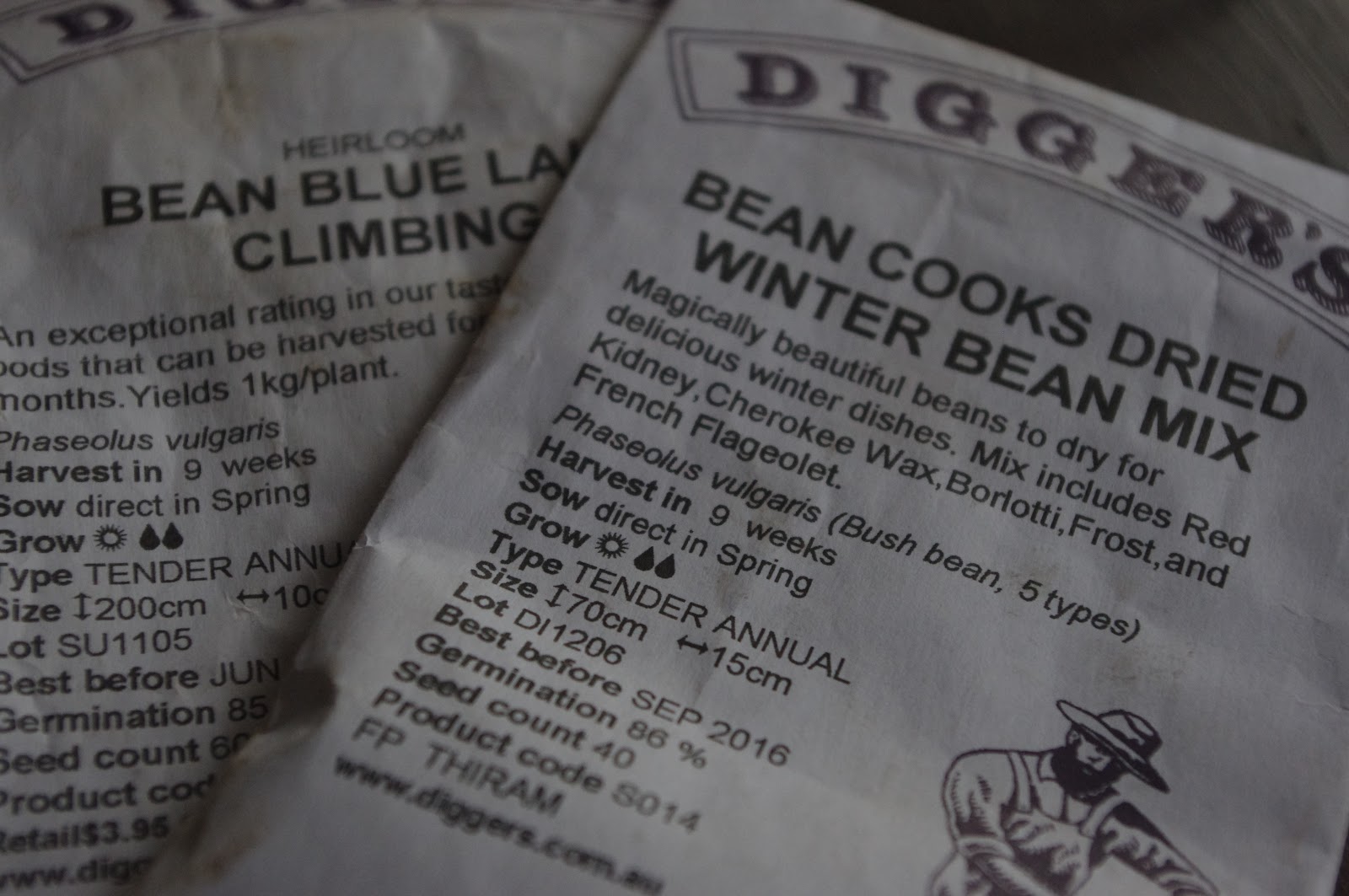
One of the first seeds I put in the new patch were climbing bean seeds. I put in a row of Blue Lake as soon as I had a bed and wire for them and they came out of the ground quickly and strongly. In fact, while I didn't count, I think I got pretty much a 100% germination? Yippee! - off and running.
I am growing lots of beans this season, of course because I like eating them, but also because I want all they can offer - their food value as well as their nitrogen fixing nodules to contribute to the ongoing fertility of the hastily built beds.
Here is what I have in :
But I have a problem - I have a mystery tip nipper. As mentioned, the Blue Lake came up quickly and well and looked fantastically strong little plants. But something was odd, they didn't seem to go past their cotyledon stage (the first two baby leaves of a plant). Surely they'd start to send up their first real leaves and their searching tendril-like thin stem looking for the wire to support them and they'd get climbing soon, right?
I kept looking each morning for action, but there was none, what was wrong? Down on my hands and knees I closely inspected the growing tip of the Blue Lakes - it seem as if they have been nipped out!
Who is my mystery tip nipper - any ideas? And any ideas on how I can protect the other beans about to burst out of the ground?
Here I am mid-December and beans stuck at cotyledon stage forever. Better get sowing another row!
I am growing lots of beans this season, of course because I like eating them, but also because I want all they can offer - their food value as well as their nitrogen fixing nodules to contribute to the ongoing fertility of the hastily built beds.
Here is what I have in :
- Climbing beans - Blue Lake
- Dwarf beans for eating green - Sex without strings (strange name) a yellow bean
- Dwarf beans for drying - Red kidney, Borlotti, Cherokee wax
But I have a problem - I have a mystery tip nipper. As mentioned, the Blue Lake came up quickly and well and looked fantastically strong little plants. But something was odd, they didn't seem to go past their cotyledon stage (the first two baby leaves of a plant). Surely they'd start to send up their first real leaves and their searching tendril-like thin stem looking for the wire to support them and they'd get climbing soon, right?
I kept looking each morning for action, but there was none, what was wrong? Down on my hands and knees I closely inspected the growing tip of the Blue Lakes - it seem as if they have been nipped out!
Every single one of the baby plants has had this treatment - just as if I had used my (dirty) finger nails to take the tip out myself.
What on earth would nip out the new growing tip of a bean plant? I have grown beans for years and years and never seen this happen before. There was no other damage - no slug activity, no nipping off at ground level which might indicate cut worms, no eating of the whole plants, no obvious foot prints of wallaby or possum...
Who is my mystery tip nipper - any ideas? And any ideas on how I can protect the other beans about to burst out of the ground?
Here I am mid-December and beans stuck at cotyledon stage forever. Better get sowing another row!
Saturday, 7 January 2012
Going back in time
I started writing for this blog on the second day of the new year and now post those entries here in blog order!
Frid 6th January 2012
· More zucchinis
· Half a punnet of brown berries
· 5 small eggplants
ZUCCHINIS
That’s it, I have to do something with the zucchinis in the fridge. They are building up and it will be zucchinis or bust for dinner.
I have only one zucchini plant in at the moment - that’s all we need obviously. I have in past gardens grown more than one zucchini plant but produce is too much to deal with. If I had more room I might stagger the zucchini planting putting one early and one later in the season to keep me in zucchinis for longer but I don’t have the room.
I have a ‘black jack’ zucchini bought from the local nursery. In keeping with the current fashion for rainbow coloured plates of food, you can also get yellow zucchinis... but mine’s just a ‘normal’ black jack one.
I pick the zucchinis relatively small - shorter than my hand and finger length, but you can pick them younger or bigger and older. They are pretty ordinary when they get too big but I can remember early in my veg growing days when I wasn’t so vigilant growing massive zucchinis and then trying to stuff them… I wouldn’t bother – they get to be tasteless and tough and are not worth it. They can get out of hand pretty quickly - you really need to check your zucchinis every two days to see what needs to be picked.
Of course you can also stuff the flowers - there are so many appealing recipes for zucchini flowers but till now I just haven’t bothered with this - it seems a little too fiddly for me but I can hear hundreds shouting, "oh they are wonderful, you should try them". Perhaps one day when I have more time.
I find that as long as you give zucchinis enough space for good airflow around them , I find them trouble free. Give them plenty of space they are large plants!
| zucchinis |
Zucchini and dill fritters with whipped feta
*Indicates produce from the garden
Whipped feta
This recipe is from ‘ Gourmet Traveller 2011 Annual Cookbook’, page 16.
Fritters
oil for frying( shallow or deep - I prefer shallow frying)
60 ml (1/4 cup) buttermilk
2 eggs
80 gm plain flower
3 zucchinis coarsely grated*
2 spring onions*
½ cup chopped dill
½ cup chopped mint*
Grated lemon rind of 2 lemons*
Whipped feta
200gm Greek feta
30 mls lemon juice*
1 clove of garlic*
50 ml extra virgin olive oil
For whipped feta, process feta, lemon juice and garlic in a food processer until smooth. With motor running, add oil in a thin and steady stream and process until emulsified.
Whisk buttermilk and eggs in a bowl then add flour and stir until smooth. Stir in zucchini, spring onions, herbs and lemon rind. Fry in tablespoon sized batches until golden. Set aside to drain on absorbent paper and serve with whipped feta and lemon wedges.
Char-grilled and marinated zucchini
Again from ‘ Gourmet Traveller 2011 Annual Cookbook’, page 16. This cookbook has lots of zucchini recipes. The recipe includes a lovely homemade flat bread which I didn’t make and thus have excluded from here.
3 zucchinis* thinly sliced lengthwise on a mandolin
120 mls extra-virgin olive oil
3 garlic cloves thinly sliced*
2 small red chillies, thinly sliced*
2 tablespoons lemon juice*
Preheat a char-grill pan on a high heat brush zucchinis with olive oil and char grill in batches, cook till tender and golden. Heat remaining oil over medium heat and add chilli and garlic, cook to infuse flavours, ( just 1-2 mins).Remove from heat , add lemon juice and add zucchini. Set aside to marinate.
Picked
· More zucchinis
· Half a punnet of brown berries
Wed 4th January 2012
Picked
· A huge bunch of sunflowers
· Half a punnet of tomatoes – berries and currant
SUNFLOWERS
Is there a greater summer pleasure than sunflowers? Each year I grow them - mostly cause they just look fantastic in the garden and even more fantastic cut in vases inside. I cut two vases worth this morning and they are now gracing our dining and lounge rooms - very van Gogh!
But they have practical purposes too - they provide a little shade for the cucumbers and they bring bees to the garden to assist with all the pollinating that needs to be done.
I grow the shorter, smaller and ‘sunburnt’ varieties - if they are shorter you can cut them more easily, if they are smaller they are more manageable in a vase. And ‘sunburnt’ you ask? We’ll I just like the bronzy and orangey shades rather than the more typical yellow ones. The flowers tend to be a little smaller too.
Each year I plant a few seeds but each year I find plants that have self-seeded thru the garden which usually result in some interesting colours - this year an extremely dark one popped up by itself.
To keep them flowering I remove the flower heads when they are starting to seed up. The spotted doves like the seed heads. I throw them on the roof of the shed so that they can graze safely away from Harriet (our cat). She finds doves easy to catch and all other birds just far to daunting (we are very grateful for her lack of bird catching ability).
….
Used up some home grown cucumbers, spring onions and tomatoes, chillies and mint in the Thai Beef Salad we had for dinner.Tues 3rd January 2012
Picked
· A punnet of brown berries
· Two zucchinis
· 5 zebras - I picked them a little early because I wanted to protect them from the fruit fly - they are ripening beside the bananas in the fruit bowl.
Planted
- A punnet of ‘little finger’ eggplants
Other
· Watered deeply and then mulched and manured
· Removed the wattle
Well the New Year has brought warmer summery weather. The 3rd day of the year and 3rd sunny day! The forecast was 28 so I watered the garden before breakfast - all water
from our rainwater tank. Normally I would have already mulched the garden, but as the weather has been mild and wet, I haven’t done so far. Today however is the day – the ground has been warmed enough now and I must get some mulch on to preserve some of the remaining moisture in the soil in the hope that this is the beginning of summer proper.
The heron paces around the garden and when it spots a skink it has a curious neck quiver before it strikes - almost always successfully.
So back to mulch - off to the local nursery - a family affair ( Eli and Marina) for a bag of sugar cane mulch, a bag of 3 in one manure (cow, sheep and chicken) my current favourite and a punnet of something to go in the spaces left by the removed bush beans.
| New baby eggplants in with older ones and mulched |
I couldn’t help it I knew they didn’t look great but I love growing eggplants. I love the plant itself - their green curved leaves with sometimes with purplish veins protected from the summer weather by downiness making them pretty well indestructible – perfect for the amateur home gardener. I have seen them survive the worst of a Sydney drought and a 35 degree plus day unwilted when everything else is struggling. And of course their mauve flowers and pendulous shiny fruit that makes a wonderful hollowy sound when you tap it to see if it is ripe. And then there is the food we make with the fruit.
This is my third planting of eggplant this year - all at different times so that I can stagger our eggplant consumption over the summer and autumn. I picked the first glut from the first planting in December before Christmas when the weather was still cool. I usually plant the long thin varieties than the round fat ones. I think they need less salting to remove the bitterness than the others and the long thin type normally flower more and in bunches so that you get lots of smaller eggplant all in a bunch.
This year I got a surprise when the fruit were lighter in colour than the usual dark dark purple ones. I wish I had paid attention to the variety cause I’d plant them again. These ones were quite seedless and the flesh soft and sweeter than usual. Was it the variety or the mild growing conditions that made that batch so tender?
David, my eggplant chef, used that glut ( or most of it) to make our favourite eggplant dish ( Spicy Eggplant) which uses a huge amount of eggplant ( and lots of home grown spring onions too!) . We usually make enough for work lunch boxes. The remainder of that glut we ate for Christmas Day - roasted on the bbq and then scraped out and made into a baharat baba ganoush.
Isn’t there a saying about eggplant? I have heard a Turkish saying once - I don’t remember where or when (maybe someone knows?). It goes something like this - a woman who can cook eggplants in 100 different ways will always keep her husband.
During lunch at the Sydney Test, David - the house pastry chef made shortcrust ready for a lemon tart which should deal with some more of the lemons picked yesterday.
Later after the cricket, we decided to cut out the wattle (a local acacia longifolia). We had been contemplating this for a while. I grew it from a tiny seedling planted it about 4 years ago (maybe only 3). It grew fast and tall and we had continually pruned it so that it didn’t shade the veggie patch too much, but ultimately it grew into a nasty lop-sided shape and it did shade the vegies anyhow and had to go.
Lemon Tart
This recipe has been adapted from ‘Orange tart with Ginger cream’ published in Australia Vogue: Wine and Food Cookbook 1995-6, page 93. I have adapted the filling to make it entirely out of lemon juice but you can mix up whatever citrus juice you have (lemons, limes and oranges). I also decided to use 4 eggs instead of 3 eggs and 1 egg yolk. I leave my pastry making to David who has the hands for it… you will have to find a shortcrust pastry recipe that you like - David added grated lime rind in this one to suit the tart.
Pastry
David’s short crust pastry
Filling1 tablespoon of arrowroot
300 ml of fresh lemon juice*
4 eggs
125g of caster sugar
100g of unsalted butter - cut into pieces
300 ml of fresh lemon juice*
4 eggs
125g of caster sugar
100g of unsalted butter - cut into pieces
Preheat oven to 200c and line a tart tin with the pastry and blind bake until it looks staw-coloured. I don’t weigh the pastry down but some will want to. Remove from oven and leave to cool.
In a bowl dissolve the arrowroot in the juice and then beat in the eggs and sugar. Make sure that you break the eggs up well. If you don’t there will be eggy lumps in the filling…kind of lemony scrambled eggs - yuck!
Pour mix into a heavy saucepan and cook gently for around 8-10 mins stirring all the time with a wooden spoon. Keep below simmering point. Soon you will find that the mixture thickens and starts to coat the spoon.
Take off the heat and whisk in the butter, pour into the pastry case and cook for about 20 mins or till set when you quiver the tin or touch the top. Leave to cool before eating.
Mon 2nd January 2012Picked
· tomatoes: just a punnet full of cherries and currants (some for dinner and lunch)
· eggplants: 4 small ones
· a bunch of spring onions (all used at dinner - Thai fish cakes and Larb Gai)
· a cucumber (used for dinner)
· lots of beans
Planted
· cucumber seeds
· padron seeds
Other
- removed the first planting of bush beans
The second day of a new year in the coldest start to summer in Sydney for some fifty years apparently and the shape of my garden reflects it. Normally I’d have a glut of tomatoes at this time of the year but this year my tomatoes are a little too leafy with lots of unripe green globes of fruit taking too long to change colour.
But yesterday, the first day of the New Year was warm and sunny and already I think I can see a ripening blush on some of the green orbs. I am looking forward to the tomato glut – not far away now. In the end I will have more tomatoes than I can really eat but I make a mistake in planting my zebras too much in the shade - the wattle and pandorea that boarder the veg patch and the native garden blocking out too much light so the zebras are a bit leggy and scraggy. It might not have been a problem in a hotter dryer year where they might have appreciated a little shade? Should I plant tomatoes there next year if we have an El Nino?
But even though my zebras are suffering I also planted lots of brown berries (which I grew and loved last year), a sugar lump (first time) and a little yellow tomato called absurdly broad ripple yellow currant (long name for a little tomato) - they were all planted in more sun.
The yellow currant tomatoes have been a real surprise. To be honest, I don’t normally get into yellow tomatoes as I have found them a little insipid, too ‘low acid’ for my taste - I enjoy the acidity of a tomato. I planted the yellow ones this year for two reasons - cause I wanted to try the currant –type tomatoes ( smaller than cherry tomatoes) and because I wanted to have a fashionable rainbow of tomatoes in my salad – just like in the gardening and cook books.
But these little yellow beauties have been great - they have ripened in particularly unripening weather, they look so cute and tiny and they taste fantastic - little explosions in your mouth.
But here I am talking about tomatoes when they aren’t in glut. So onto the current gluts.
BEANS
Today I picked all the beans on the Hawkesbury Wonders and pulled the plants out . I planted them in September these are bush or dwarf beans (I prefer to call them bush beans) that I planted because my climbing frame (a couple of stakes with chicken wire) were still fragrantly occupied by sweet peas - beautiful white ones with curly edges tinged with pink.
I never normally grow bush beans growing instead climbing beans but I’d do it again – they seem to produce more quickly than the climbings. They have also been remarkably productive - I now have a big bag of beans in the fridge that I have to do something with! I could probably have left these plants in the ground got a bit longer but my second planning of bush beans is coming on as are my climbing beans and I also wanted to make some space for another summer vegetable, not sure what yet - some more eggplants?
Anyway I pulled the bush beans out (or rather cut them off at ground level leaving the nitrogen fixing roots in). These bush beans were planted in amongst the eggplants - the first time I have done this and it seemed to work well. The plants are about the same height as each other and the beans providing valuable nitrogen for the heavy feeding eggplants. Perhaps they are companion plants? All the books have beans and tomatoes paired as happy companions but none I have read have commented on eggplants and beans as happy bed fellows. But tomatoes and eggplants are closely related and perhaps their companions are similar?
I grow beans every year and always seem to have a lack of imagination in dealing with them. They are of course a great garden snack - many never get to the back door – but I can only eat a certain amount that way.
Suggestions?
LEMONS
I currently have an enormous glut of lemons. My lemon tree (yep, I only have the one) stands proudly in the corner of the vegie patch. It was one of the first plants we planted in the garden after moving to Marrickville 7 years ago.
The branches bend with too much fruit this year. You are supposed to remove the small bulging baby lemons fruit too many are forming - but I didn’t do it this year. I think I was just so glad to see the tree producing so much after lean years during the drought.
Yesterday I HAD to collect some lemons I say ‘collect’ because not all were picked. Many had already fallen into the cushion of mulch that surrounds the tree - beautiful yellow curves in nests of dried lawn clippings like some abandoned nest of a yellow-egged ground bird. I also picked the yellowest fruit from the tree - in total two big baskets of fruit. With warmish weather I made lemonade and used lots of lemons.
Lemonade
I think I got this from the Weekend Cook a section in the Weekend Australian but I could be mistaken. I have doubled the original amounts to deal with the glut but you could scale up or down to suit yours.
500ml fresh lemon juice*
1 1/3rd cups of caster sugar
Place ingredients in a saucepan and dissolve sugar inj the juices. Remove from the heat and cool. Store in the fridge and use as a cordial to mix with water, soda water, mineral water or lemonade ( I find this too sweet).
*Indicates produce from the garden
Subscribe to:
Posts (Atom)